
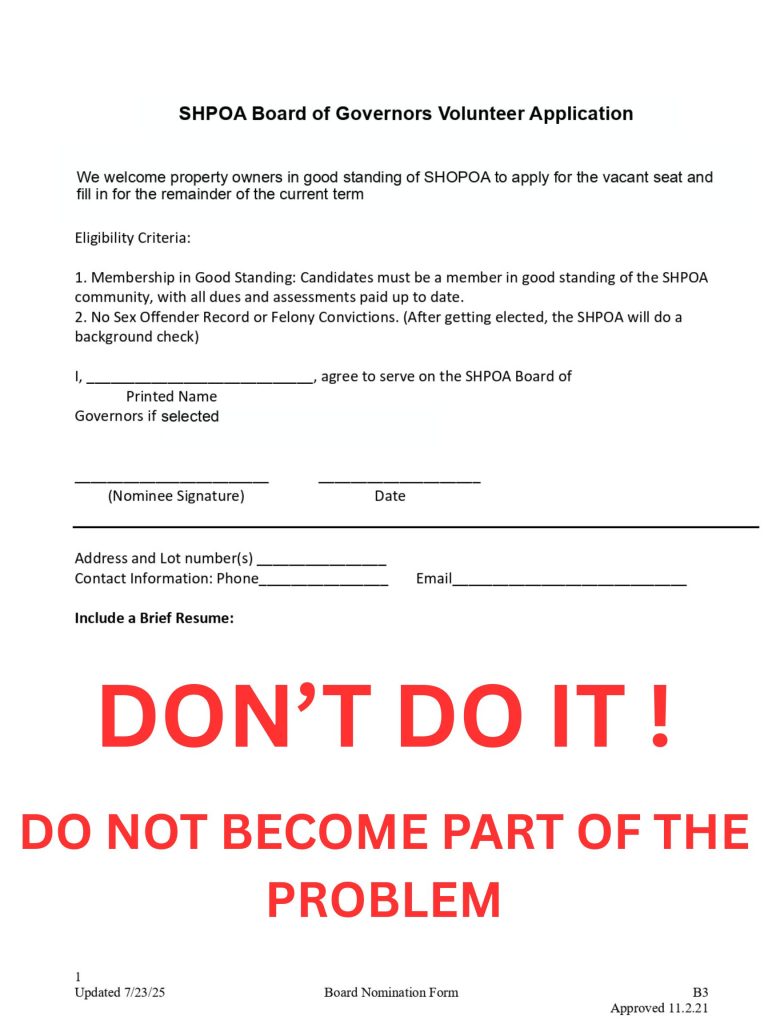
Every so often, a call goes out for “dedicated community members” to step up and serve on the Board of Governors. It’s dressed up as civic duty. A chance to “make a difference.” An opportunity to “protect property values.”
Let’s pause.
If you value your time, your sanity, and your reputation, think long and hard before you volunteer.
Serving on a board should be about transparency, collaboration, and stewardship. It should be about listening to neighbors, solving problems fairly, and acting in the best interests of the whole community.
But when boards devolve into cliques, something very different happens.
Instead of open discussion, you get whispered side conversations.
Instead of honest disagreement, you get gaslighting.
Instead of principled leadership, you get power plays.
And once you’re inside that circle, you’re faced with a choice: go along to get along, or become the next target.
Many well-meaning homeowners step up thinking they’ll bring fresh perspective and integrity. What they don’t anticipate is the pressure to conform. The subtle rewriting of events. The “that’s not what happened” conversations that leave you questioning your own memory. The expectation that loyalty to the group matters more than accountability to your neighbors.
Board politics can quickly turn into backroom maneuvering. Personal alliances form. Agendas get protected. Dissent gets sidelined. And suddenly, what was pitched as volunteer service feels more like a battleground of egos.
Here’s the uncomfortable truth: some people don’t volunteer to serve — they volunteer to control. Titles become identity. Authority becomes addictive. And the board seat becomes less about responsibility and more about status.
If you join that environment, you risk being pulled into dynamics you never signed up for. You risk being associated with decisions you may not fully support. You risk becoming part of a system that values power over principle.
That doesn’t mean communities can’t be well-run. It doesn’t mean good governance is impossible. It means you should walk in with your eyes wide open.
Ask yourself:
- Is the board known for transparency?
- Are meetings respectful and documented?
- Are dissenting opinions welcomed or punished?
- Do decisions reflect community input — or a small inner circle?
If the answers make you uneasy, stepping back may be the wisest move.
Not volunteering is not apathy. It’s discernment.
Protect your peace. Protect your reputation. And don’t feel obligated to step into a dynamic that may compromise your integrity.
About the Author